
Built for regulated clinical settings
Policy conflicts stay invisibleuntil someone acts on one
One governed workflow
Close the loop from policy review to clinical practice
Clinical guidance breaks down when policies conflict, fall behind requirements, or remain difficult to use during care. Karibu connects policy alignment, clinical review, and point-of-care delivery in one governed workflow.
Surface the gaps
Surface conflicts within and across policies, regulatory blind spots, and areas where guidance may lag current clinical evidence.
Clinical leaders decide
Give clinical leaders a structured starting point for review.Findings remain recommendations until the organization approves them.
Guidance at the point of care
Turn approved policies into answers care teams can act on, with escalation when policy is silent.
Policy alignment
Find the gaps that are difficult to see manually
Reviewing a policy set line by line takes hours per document. Karibu produces a structured review across four areas, with each finding quoted and page-referenced for clinical decision.
Conflicts within a policy
Identify instructions, definitions, or requirements that contradict one another inside the same document.
Example: A threshold in the body that does not match the figure printed on the log.
Conflicts across policies
Surface inconsistent guidance across documents that govern related workflows.
Example: Two documents covering the same practice stating different limits.
Regulatory blind spots
Highlight areas where policy coverage may not address relevant regulatory requirements.
Example: A required element with no corresponding policy coverage.
Gaps against current evidence
Identify areas where approved policy may warrant review against current clinical evidence.
Example: Guidance that predates a change in the underlying standard.
Karibu surfaces findings for qualified clinical review. The organization retains authority over policy interpretation, approval, and revision.
Point of care
A clinician asks at 2am.Karibu answers from your policy, or routes them to escalate.
When policy covers it
An answer they can act on
Patient’s blood pressure dropped to 82/48 mid-treatment and they’re nauseated. What do I do first?
Stop ultrafiltration and lay the patient flat, then give the saline bolus your unit’s protocol specifies and recheck blood pressure. If it does not recover, notify the nephrologist before restarting fluid removal. Record the event on the treatment record.
Your organization, approved policyWhen policy is silent
A route, and a flag for the policy owner
Family is asking about home dialysis training and we don’t run a home program.
Approved policy does not cover this. Escalate to the charge nurse and the nephrologist per your escalation path. This question has been logged for the policy owner.
Routed to the policy owner, 2 open questions this weekEvery silent question becomes a queue item, so gaps surface as a list instead of a rumor.
Supporting teaching layer
Teaching that reinforces approved guidance
Karibu turns approved policy content into short, scenario-based conversations. The experience adapts to what each learner misses, repeats key concepts, and uses teach-back to strengthen understanding.
Conversational teaching with scenario practice and teach-back.
Regulated clinical settings
Built for hospital specialty service lines
Karibu works where a service line owns its own policy set and is held to national standards it did not write. Specialty service lines are where we start.
Specialty clinical service lines
Policy alignment against the federal and national standards a program is held to, and the survey worksheets it is judged on. Point-of-care answers on shift.
Across a health system’s units
Decisions made on one unit’s policy set become rules applied to the next, so each service line costs less to align than the last.
See it run on your own policies
Start with one service line and a defined policy set.
Works on any device
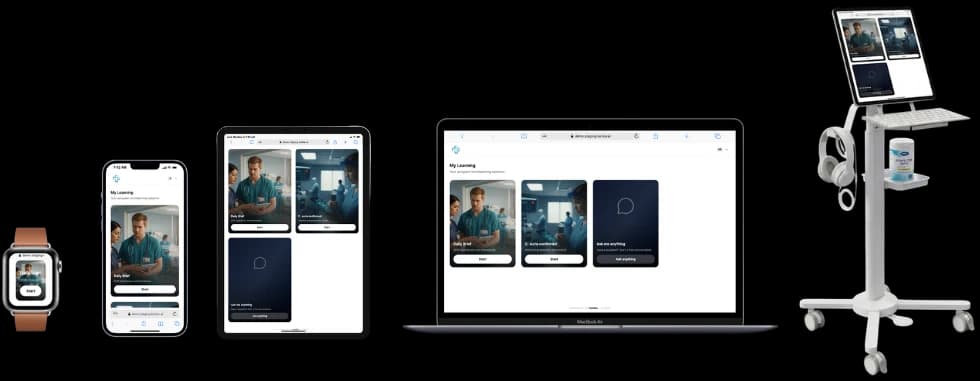
Designed for low-friction deployment
Karibu runs in a standard browser and can begin with a bounded, non-PHI policy workflow. Authentication, access controls, security review, and system integration are defined with each organization.
Flexible access models
Karibu supports browser-based access and can be configured around the organization’s identity, device, and deployment requirements.
Works alongside your systems of record
Karibu adds a review and delivery layer for approved content while your existing platforms remain the source of record.
Clinical authority stays with you
Karibu does not outsource clinical judgment.
It gives a care team source-bounded answers from approved policies,escalates when those policies are silent, and leaves clinical authority with the organization.
Governance and safety
Clinical authority stays with the organization
Karibu supports clinical review and delivery while policy owners retain control over approved content, permitted sources, escalation paths, and release decisions.
Source bounded
Answers use the organization’s approved content.When policy is silent, Karibu directs the user to escalate.
Human reviewed
Findings and generated learning content remain subject to review by qualified organizational stakeholders.
Organization controlled
The organization defines policy ownership, approved sources, access, escalation, and release decisions.
Measurable
Interactions and feedback support evaluation, monitoring, and continuous improvement.
Evidence and clinical authority
Designed around clinical evidence and responsible AI
Karibu’s design principles are grounded in peer-reviewed research.
The evidence behind Karibu
The peer-reviewed research behind every design principle.

Copyright © 2026 Karibu Connect Inc. | info@karibu.ai | San Francisco, CA
Last updated: August 7, 2026.